A swan rescue charity got 385M views in six weeks. Its long videos didn't change at all.
5 min read
The Waterfowl Sanctuary posted the same rescue twice on the same evening: 2.2M as a regular video, 199.8M as a Short. What changed on October 8?
By viralshooter
On this page
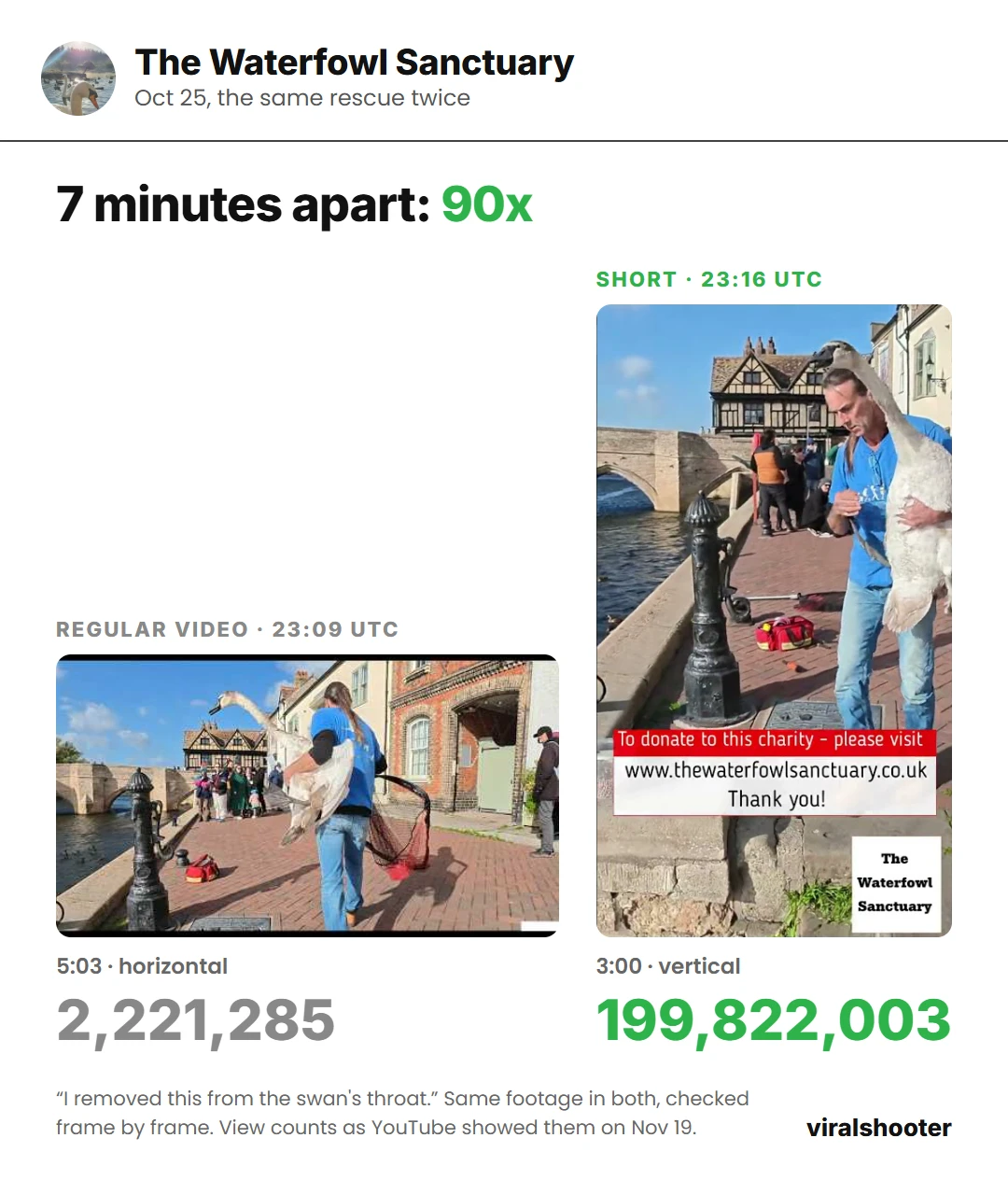
On October 25, a small UK charity posted a video of a man pulling something out of a swan's throat.
Seven minutes later, it posted it again.
The first upload has 2.2 million views. The second has 199.8 million.
That's the clearest single example of what happened to The Waterfowl Sanctuary, a wildlife rescue charity that films its swan rescues and puts them on YouTube. From January 1 to October 7, the 46 videos it uploaded in 2026 got 20.7 million views between them. In the six weeks since October 8, its 18 new uploads have got 385 million.
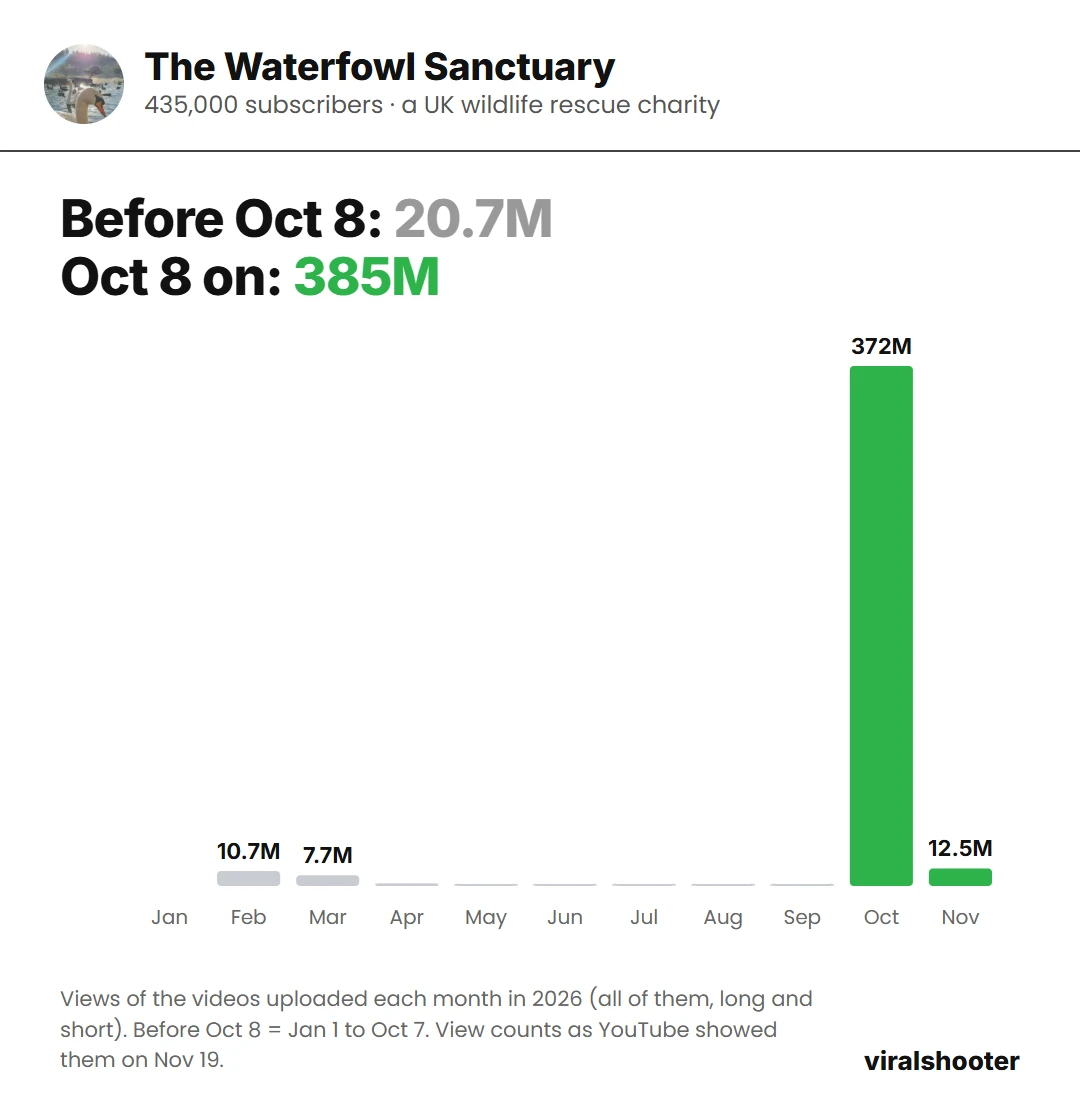
The easy explanation is that swans went viral. Animal rescue does well on YouTube, one video took off, and the algorithm sent everyone to the rest.
That's not what the numbers say. Let's go through it.
The quick version#
- What changed: from October 8, nearly every rescue went up as a vertical Short of three minutes or less, with three hashtags in the title. Several old rescues were cut down and posted again.
- What didn't: the long, horizontal videos. Their typical upload got 72K before October 8 and 77K after.
- The proof: on five days the charity posted the same rescue both ways. The Short won every time, by 4x to 152x.
- What we don't know: whether the views turned into donations, and why November is quieter so far.
First, the hits were not new#
The charity didn't come out of nowhere in October. Its first big batch of uploads was in February, and one of them, "Hooked in Huntingdon," did 5.6 million. In March, a video of a swan so covered in leeches it couldn't see did 2.9 million.
So for most of the year this was a channel that sometimes had a big video and mostly didn't. Between April and September, uploads usually got 6K to 150K.
And here's the part that rules out "they just made shorter videos." The charity had already posted short ones. Of its 46 uploads in 2026 before October 8, 12 were three minutes or less. Their typical view count was 9,000, lower than the long ones.
Short, on its own, wasn't working.
What changed on October 8#
On October 8 the charity posted "Daddy swan protects his baby during rescue," 2 minutes 56 seconds, as a Short, with "#wildliferescue #swan #swanrescue" in the title. It has 70.6 million views.
From then on, almost every upload followed the same shape:
- Vertical, not horizontal. The rescue footage is cropped to fill a phone screen.
- Three minutes or less. Six of them land at exactly 3:00, the longest a Short can be. They look cut to the second.
- A plain title plus three hashtags. "Tethered cygnets #wildliferescue #swanrescue #animalrescue." No hook, no capitals.
- The same donation card near the end: "To donate to this charity, please visit" with the charity's website.
Thirteen uploads since October 8 are three minutes or less. Their typical view count is 10.7 million. The five that don't, the regular horizontal videos, have a typical count of 77,535. That's where they were before.
The same rescue, posted twice#
This is the strongest evidence, because it removes the "maybe it was just a better rescue" question.
On five days, the charity uploaded one rescue as a regular video and as a Short, never more than 78 minutes apart. We checked three of the pairs frame by frame. It's the same rescue, cropped differently.
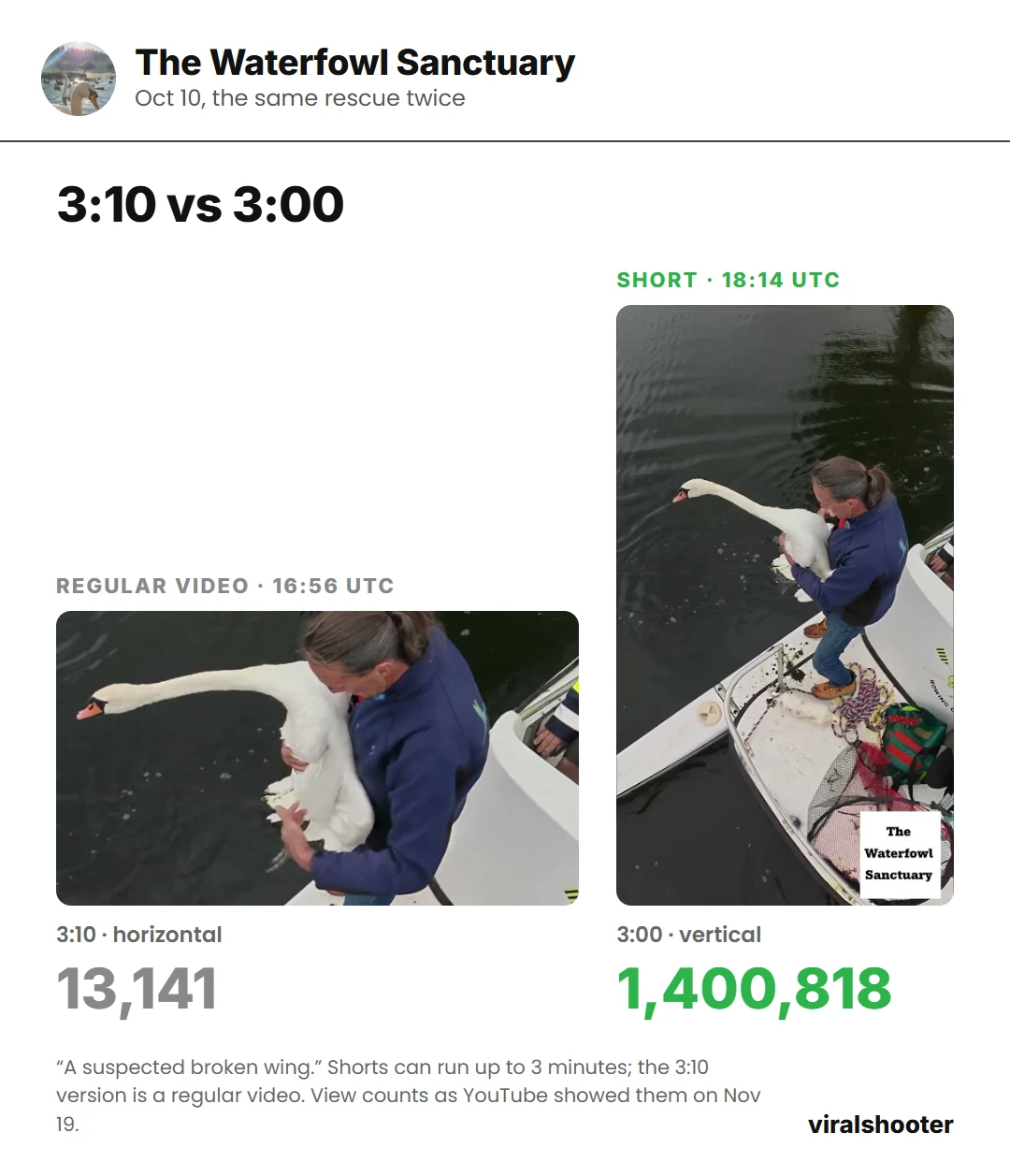
- Oct 10: regular video 3:10, 13,141 · Short 3:00, 1,400,818
- Oct 20: regular video 6:22, 1,573,190 · Short 2:56, 5,907,242
- Oct 25: regular video 5:03, 2,221,285 · Short 3:00, 199,822,003
- Nov 4: regular video 4:58, 77,535 · Short 2:59, 11,770,005
- Nov 11: regular video 4:02, 16,598 · Short 2:51, 685,259
The October 10 pair is my favourite. The regular video is ten seconds longer than the Short. Ten seconds and a crop: 13 thousand views against 1.4 million.
Then it went back through the archive#
The other thing the charity did was go back to rescues it had already posted, sometimes months earlier, and put them out again as Shorts.
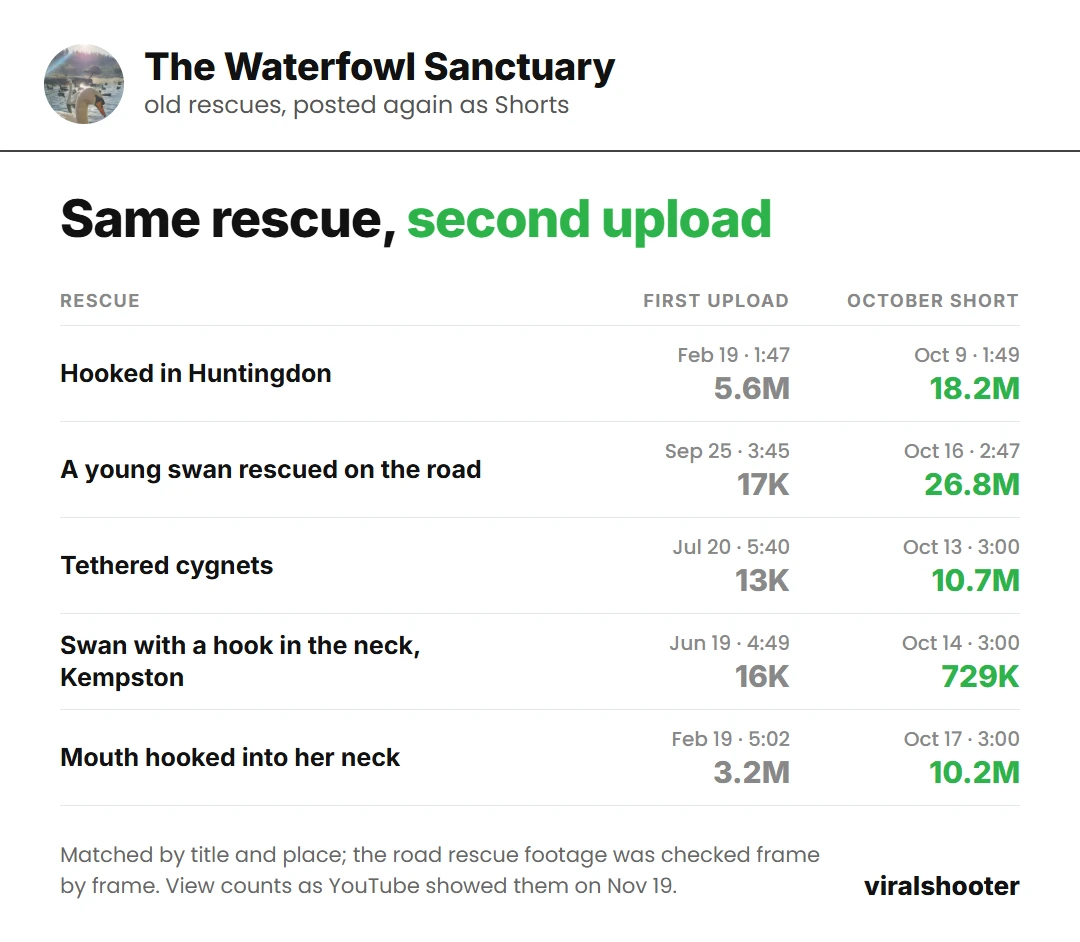
The motorway swan is the cleanest case. "A young swan rescued on the road" went up on September 25 at 3:45 and got 17,083 views. Three weeks later it went up again at 2:47, vertical, and got 26.8 million. Same swan, same police officers, same road.
"Tethered cygnets" from July: 13K the first time, 10.7M as a Short. "Hooked in Huntingdon," which had already done 5.6M in February, did 18.2M again in October.
So the charity didn't need new rescues for its biggest month. It needed the ones it had, in a different shape.
What we don't know#
Did it raise money? Every Short ends with the donation card. A few hundred million views of it should matter to a small charity, but donations aren't public.
Why is November quieter? The two November Shorts so far did 11.8M and 685K. That's still far above the old normal, but below October. It could be the archive running out of its best stories, or just a slower month. Six weeks is not much data.
Why the earlier short videos didn't work. We didn't check how the 12 short uploads from before October were filmed or framed, so we can't say whether they failed for the same reasons the regular videos do.
Things to try#
If you have long footage sitting on your channel, this is the useful part:
- Sort your long videos by views and pick the five best stories. Not the best videos, the best stories. The charity's biggest Short is a rescue whose long version did 2.2M the same night.
- Cut each one to three minutes or less, vertical, with the one moment people would describe to a friend. Try a version that ends exactly at the moment the story resolves.
- Post the Short the same day as the long one, or a few weeks after. You'll find out quickly which of the two your audience wants.
- Keep the title plain. The charity's titles say what happens and add three hashtags. The rescue is the hook.
Data: YouTube public view counts for all 68 Waterfowl Sanctuary uploads, pulled November 19, 2026. Times UTC. Pairs matched by title, place and time; the October 10, October 25, November 11 and motorway pairs were checked frame by frame.